The Border Collie
Get to know the Border Collie, a dog breed bordering on brilliant

There’s an old joke in the sport of dogs about a man who was thinking of sending his Border Collie to a well-respected handler for some training. The punch line being, of course, that the man should leave the dog at home and go himself. Ironically, therein lies more truth than was intended.
Border Collies have been bred for hundreds of years with a single goal in mind: improved herding ability. Because of this, they are high-drive, high-energy dogs that move faster than the speed of gossip. Unmatched in brains, instinct, and endurance, they can do just about anything—and do it superbly. Someone once said they are so smart they can pick your pockets clean and leave you smiling about it. Picking pockets may be a good side gig, but their day job is “premier sheepdog.” They are the working stiffs of the herding world, and they live it morning ‘til night.
History of the Border Collie
Sheepdogs have been around in some form or fashion for thousands of years. Much of what is known about their origin and early history is based on nineteenth-century literary tales, a bit of archeological evidence, and a good deal of speculation. Biblical references, such as Job 30:1, refer to dogs with flocks. Roman scholar Marcus Terentius Varro (116 B.C. – 27 B.C.) wrote about the care and training of shepherd dogs, and about a sheepdog he procured as a watchdog. Dr. John Caius’s book Treatise on Englishe Dogges, written in 1570, is considered one of the earliest references to working sheepdogs in Britain. Interestingly, his description, written more than 400 years ago, bears an uncanny resemblance to the working style of today’s Border Collies.
The earliest sheepdogs, in all probability, descended from guard dogs similar to those that accompanied the Romans when they invaded Britain in A.D. 43. These dogs were most likely crossed-intentionally or unintentionally-with other dogs, including the herding Spitz-type dogs belonging to the Vikings who invaded Britain between the eighth and ninth centuries.
What is known for certain is that the modern-day Border Collie is a product of the pastoral borderland between England and Scotland where shepherds needed a sturdy, trainable dog that would flaunt its natural herding and intellectual prowess while working long hours over rugged terrain. Of course, back then, most dog breeds were not clearly defined, and the Border Collie wasn’t yet a Border Collie but simply a “collie” or sheepdog. These collies remained strictly working sheepdogs until the 1860s, when several events raised their profile and their popularity.
Rumour has it that Queen Victoria first saw the rough-coated collies at Balmoral Castle in the Highlands of Scotland and took an instant liking to them, which quickly elevated them to royal status. Dog shows were also becoming fashionable, and it didn’t take long for collies to find their way into the show ring. Shepherds in Britain supplied many of the early show collies, but they quickly realized they would be toying with disaster if they tried to breed a dual-purpose dog for both show points and working ability. This was a critical juncture for the Border Collie we know and love today.
By the turn of the twentieth century, the separation between working collies and show collies was well under way. Shepherds continued breeding their collies with an emphasis on working ability rather than physical appearance, and the show collie eventually morphed into a breed of its own-the Rough Collie-and founded a dynasty of glamorous canine movie stars who portrayed the ever-popular Lassie. The Border Collie, on the other hand, continued in its “character” role as the tough, hard-working kid with rangy good looks.
The advent of sheepdog trials in 1873, perhaps more than any other event, helped to establish the modern Border Collie’s heritage through selective breeding programs that favored the quality of “eye” and the overriding importance of working style, ability, and durability.
Today’s Border Collies remain relatively unchanged from the dogs of the 1800s and early 1900s and, like the shepherds of old, today’s working Border Collie owners prize herding instinct. They oppose any organization or written description that emphasizes physical appearance over working ability.
In 1994, the American Kennel Club (AKC) accepted the breed for show-ring competition despite heated debate among breed aficionados. It was a feud that rivaled the Hatfields and McCoys, and it still continues to this day. Owners of working Border Collies fought tooth and nail against AKC recognition, fearing that once the breed began to appear in the show ring, its herding ability would no longer be a primary focus, and Border Collies would become pets and companions rather than superior workmates. For these reasons, Canadian owners opposed kennel club recognition in that country and succeeded in blocking it.
Life On White/Bigstock
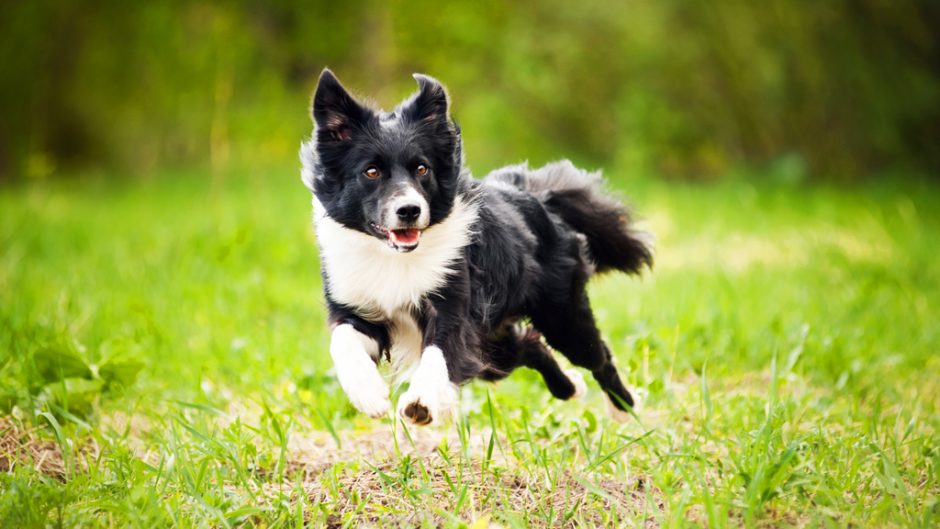
The Border Collie Classic Look
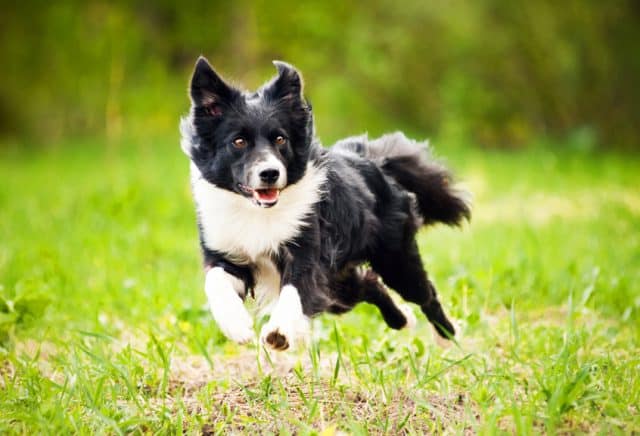
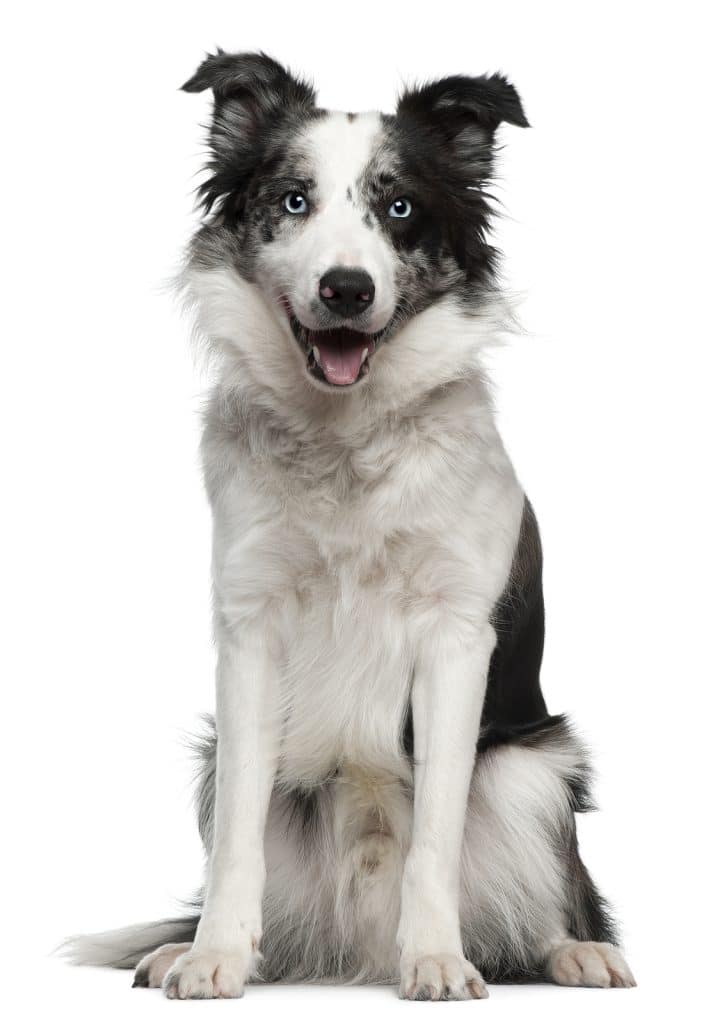
One result of the traditional emphasis on working ability rather than physical appearance is that Border Collies come in a remarkable variety of colours and markings. They can be solid, bi-or tri-colored, red or blue merle, and even brindle-all with varying amounts of white. The colour pattern most commonly associated with the Border Collie is black with a white blaze, white collar, feet, chest, and tail tip. The coat can be smooth or rough, or anything in between.
Although the AKC standard states that the height at the withers varies from 19 to 22 inches for males, and from 18 to 21 inches for females, working Border Collie owners would never favour a particular height over herding ability, and, indeed, the standard reads: “Overall balance between height, length, weight and bone is crucial and is more important than any absolute measurement.” Contemporary show dogs tend to be shorter in leg with heavier, well-manicured coats. Working dogs have a rangier look with a more moderate coat.
The Border Collie Temperament
The AKC breed standard also describes a dog with extraordinary instinct, an uncanny ability to reason, endless endurance, trainability, and extreme intelligence. Unfortunately, these qualities that make them superior working dogs are the very qualities that can make them unsuitable as pets. They are workaholic dogs with type-A personalities and get-it-done-right-now attitudes. Napping is a waste of time for any self-respecting sheepdog.
Louis Irigaray, a shepherd for 30 years and author of the book A Shepherd Watches, A Shepherd Sings, writes: “The dogs are workers, employees paid with an evening meal and a pat on the head…If the sheep are to be dipped in a hole in the ground, bathed in the chemical creosol to kill lice and ticks, five thousand of them headed for a hated swim, canine power sends them out of the corrals and into the tanks. There are no union problems and no other workers on earth are as anxious to get on with the job at hand.”
In the absence of adequate physical and mental stimulation, Border Collies quickly become bored and destructive. They can be obsessive, and their obsessions take many forms. They are famous for attacking moving objects, including lawnmowers, weed-whackers, and vacuum cleaners. Rakes, brooms, and snow shovels are equally stimulating to them. Others have been known to attack wheelbarrow tires, puncturing them with a single bite. Most Border Collies are passionate about tennis balls and toys, and they will gleefully shake cherished rugs, pillows, and carelessly discarded garments into oblivion.
These intelligent, complex creatures are also known to develop compulsive behaviours. Some become mesmerized by reflective surfaces, such as mirrors, glass, or the stainless steel on refrigerators and dishwashers. Others go berserk at the sight of a fly. Some snap at the rain. Others spin in endless circles and almost all of them have a propensity to herd small children by biting and nipping at their ankles.
Overview: Should You Have a Border Collie as a Pet?
A Border Collie will always win your heart, but prospective owners must carefully consider their own lifestyle before committing to a 12- to 15-year relationship. While these dogs are a wellspring of affection and comfort, there are important physical and mental requirements associated with owning one. Border Collies are happiest when they are working. Few, if any, ever detox from their state of constant motion. It’s not good enough for owners to merely think they have the upper hand-they must remain two steps ahead at all times.
Border Collies are a good choice for farmers, ranchers, country dwellers, and marathon runners who understand the importance of including their four-legged friend in their day-to-day activity, whether that be herding, farm chores, jogging, hiking, swimming, or riding shotgun in the family car. Despite their propensity for obsessive-compulsive behaviours, calamity, and trouble of all degrees, life would be a much more boring without Border Collies.
» Read Your Breed For more breed profiles, go to moderndogmagazine.com/breeds
Join the newsletter and never miss out on dog content again!
"*" indicates required fields
By clicking the arrow, you agree to our web Terms of Use and Privacy & Cookie Policy. Easy unsubscribe links are provided in every email.
Dog breeds that don't shed: the top 10 dog breeds that shed the least—and 10 that shed a lot!