The Emotional Dog

Why your dog is your mirror by Kevin Behan

Why Do Dogs Perform CPR?

March 9, 2012
Many years ago when I first heard of dogs predicting epileptic seizures in their owners, I found it hard to believe. But as I pursued my emotion-as-energy theory of behavior it eventually came to make perfect sense. Now the internet carries reports of dogs reviving owners suffering a heart attack by CPR, actually punching their chests and licking their faces until they regained consciousness. The doctors who attended credited the dog with saving its owners' life. You have to wonder is mouth-to-mouth next?


http://dogsinthenews.com/stories/070329a.php


http://www.brisbanetimes.com.au/queensland/dog-given-medal-after-canine-...


But does the dog comprehend that he is saving his owner's life? No I don't feel this is what's happening. What's going on is far more sublime, transcendental and "super" natural than that. It's a function of emotion itself.

Dr. Wolpert, a leading neurobiologist from Cambridge University, maintains that the brain, and all its higher cognitive modules, evolved in service to motion. In my experience as a dog trainer this means that a dog sees and perceives things as a function of motion relative to resistance-to-motion. The motion of something means emotion is flowing within the dog. Whereas resistance to motion increases emotional pressure in the dog. We could say that motion divided by resistance = the emotional value of a stimulus, or feeling. (M/R = F)

You can test this for yourself. You could set up a situation where your dog is watching as you move across an area. The smoother and the faster you move, the more your dog becomes excited or perhaps just watches without perturbation. He feels your motion and is energized in a positive way. But then if you begin to stiffen your gait as if your muscles are bogging down into an emotional rigor mortis, your internal flow of energy becoming tension, you may see your dog begin to inflate with an internal pressure, its tail raises, its hackles might rise as it braces itself on all fours, it's gathering itself. It's feeling your tension, i.e., your internal resistance to motion.

Then, as you grindingly come to a halt, you slowly turn and face your dog while simultaneously increasing the intensity of your focused attention his way, the ultimate body posture of resistance (bearing in mind that this could incite an explosive burst of energy so as you do this take care to turn the knob on the rheostat (flow relative to resistance) carefully). Or, you could not do this experiment with your own dog and simply watch "helpers" working police dogs. Smooth body motion happily animates the dog, tension in the helper's body pressurizes the dog. This is basic body language on a continuum of motion relative to resistance-to-motion. Motion relative to resistance-to-motion is the predicate of emotional experience in every interaction between any two emotional beings.

Let's break it down further. Life on earth is about overcoming objects of resistance and this requires a two step process. First, when a dog sees something in motion, emotionally, it projects its sense of its physical center-of-gravity into the moving form and in this way it is able to apprehend the physical center-of-gravity of the object in motion. An object in pure motion is a simple object-of-attraction. And because inside every animal is an on/board genetically encoded calculus, it is able to "feel" or calculate where that object of attraction is going to be as it proceeds along its current trajectory.


("The Math Instinct" )


http://www.amazon.com/Math-Instinct-Mathematical-Genius-Lobsters/dp/1560...


This intuitive math is how a dog "knows" how to catch a frisbee because in order for a predator to catch a prey it has to be able to calculate what the prey is going to do and where it is going to be before it gets there. Think of the classic footage of a cheetah catching a gazelle. WIth every twist and turn of the gazelle, the cheetah shaves each corner so as to gradually narrow their respective trajectories until at a point of intersection it can knock the gazelle off stride and finally overtake it.

However this simple computation isn't enough when dealing with complex objects of resistance, by this I mean those animals that have the physical capacity to fight back in order to maintain equilibrium, and this is especially true for the dog given that it evolved from the wolf which hunts a prey that is much bigger and physically superior to itself. The epicenter in the anatomy of any emotional being that has the capacity to resist, is the shoulder assembly or forequarters. And so the next level of apprehension in this emotional template is where on the prey's body a predator would be able to exert maximum physical leverage so as to bring it down against this fulcrum point of resistance.

Now even though we're talking about a dog relating to its beloved owner in everyday life and in some rare cases of going on to perform CPR, we're still dealing with the archetypal emotional template with which the animal mind (the human animal included) perceives reality and makes sense of the things toward which it feels attracted. What I'm headed for here is that animals look at complex objects of resistance by assaying their heart, and the grossest physical manifestation of what's going on within the heart is manifested by the degree of "upward thrust" in the forequarters that maintains the organism's equilibrium and thereby sustains the possibility for forward motion.

When a body is in motion, all the forces of acceleration and lateral, side to side motion, the up and down forces of body mechanics, all of these average out and are held in "memory" by the heart, which is of course housed in the epicenter of the shoulder assembly. This is where the individual feels a sense of flow (equilibrium plus momentum). For example, when someone's shoulders are slumped this indicates a deflated heart. The dog perceives the shoulder region and its "upward thrust" as the epicenter of resistance in complex forms of attraction, its owner included. This is the region against which predator must leverage all its physical energy to overcome the prey's capacity to preserve its balance and keep fighting or get away. This is the region against which the dog must leverage its emotional and/or physical energy in order to feel connected to its owner. In the prey/predator dynamic when the predator has leverage, the prey is brought to ground. (This is why bulldogs target the bull's nose.) In the dog/owner dynamic when the dog has emotional leverage, the dog FEELS CONNECTED, i.e. its emotional energy is brought to ground (this is why dogs can be driven to get in another dog or person's face in order to assure contact).

We see this template in all behavior. A lion will jump on the back of a large prey and try to topple it over by making it top heavy and leveraging against its upward thrust. Also note how one dog will approach and then ride its chin up on the shoulder region of another dog and then begins to press down. This has been misinterpreted as establishing dominance, but the "dominant" dog is just trying to overcome the other dog's upward thrust, or resistance, as a first step in making contact. Finally, the equal and opposite of overcoming resistance, is when a dog surrenders its own epicenter of thrust by rolling on its back and writing its shoulder blades against the ground. It's feeling connected to the earth, especially if aroused by fresh snow, wet dew, carrion or you know what, or even as an indirect means of feeling connected to another dog it would like to play with.

As further evidence that this is a universal mode of apprehension, below is a link to a dog performing CPR on a ball at rest.


http://www.youtube.com/watch?v=oaF91ZDQuSA


Most dogs, unlike the one in this video, perceive a ball as a simple object of attraction and only chase one when it's thrown. The resistance value is added by the owner. There are a lot of dogs however that will play with a ball by themselves, and this means they are projecting a "negative" onto its positive value of motion and from this the ball attains the complexity of a Being in the dog's mind. It becomes an object of resistance that thus engenders a complex emotional value, for example, as was portrayed in the movie "Castaway" with the relationship that developed between Tom Hanks' character and "Wilson." And while most dogs that harbor an imaginary ball friend in their mind, are content to just nudge, pounce, or grab-shake-toss a ball to get it moving, in the video this particular dog is zeroing in on the source of resistance within the ball and hitting its center mass perfectly so that the dog's force is reflected right back to it. This return force penetrates to the epicenter of the dog's upward thrust, i.e. its heart, and then with exquisite timing the dog beats out another pulse. Energy out, energy in, a perfect feedback loop that links the ball's center mass to the dog's heart. Because of the elasticity of the ball, the dog's energy is returned to it with no loss of momentum and this full return of energy enables the dog to project more and more complex feelings onto the ball, just as if it is dealing with a living being. And this is because a fundamental principle of motion, that every action has an equal and opposite reaction, is how an animal's mind constructs a sense of its "self" from its interactions with the external world. It then perceives this self in complex objects of resistance, be they animate or inanimate if such things can reflect energy right back at the dog in equal measure. (This emotional jujitsu is how a cat acquires for itself a high resistance emotional value in a dog's mind and thereby trains it.) This equal/opposite emotional rhythm is essential for emotional synchronization so that a social relationship can emerge. It is not hyperbolic or metaphorical to say that the dog in this video is feeling exactly what the ball is feeling because on the grossest physical plane of consciousness, they are indeed experiencing the same back and forth of energetic forces.

Now most of us are probably not going to be able to count on our dog rushing to the rescue by performing CPR if heaven forbid one day we should need his cardio resuscitation services (although a good face licking is probably a given). However, nevertheless we can be assured that each and every day our dog is running its canine-cardio diagnostics on us whatever we may be doing. It is always feeling what's going on in our emotional epicenter. In my view this is more sublime than any "Lassie; HURRY, Go Get the Sheriff" romantic fantasies Hollywood knows we like to enjoy. The truth is that nature is a mirror, it can reflect our fantasies back to us, or it can reflect something rather remarkable: Heart is real.

comments (0) >> click here

Why Do Dogs Stot?

January 12, 2012

Sometimes when gazelles spot a lion or cheetah on the Savannah, rather than running away at full speed, they stot wherein they punch the ground with their forelimbs, stiff-legged, and with a hunched back, propel themselves high in the air in a series of bounds. For a moment between leaps, they float, suspended in mid air.  


According to mainstream biology the stot is an ostentatious display of fitness that indicates such a state of physical robustness that a predator would be discouraged from giving chase, saving all a useless waste of energy. Once however a pack of wild dogs was observed to almost take down a stotting gazelle since it was basically bounding in place rather than putting distance between it and the dogs. But the most interesting question is; if gazelles stot to discourage being chased, why do dogs stot?


Physics teaches that nature conserves energy, it can never be destroyed. Biology similarly teaches that successful adaptations are likewise conserved as they tend to radiate throughout a genome and evolve into further functionality. I would take the principle of conservation one step further, just like energy, information is never destroyed, it is always conserved, and a case in point is the dog stot. 

One of the dogs of my children's childhood years, was "Barley," the worlds' cutest tricolor Corgi. Barley was the only dog welcome in the garden as he could meander amongst the flowers and sit slumped onto the side of his little tush without bending a stem or crinkling a petal. He was a comedic genius, a talent amplified by the inventive games mutually arrived at with my children, such as snatch-the-scrunchie-off-the-pony-tail game. But we would often say "poor Barley" because everything about him was a study in self-defeating contradictions. He had a big head with German Shepherd chiseled features but then his ears were so large that instead of looking sharp and alert when he cocked his head, he looked like an antennae array swiveling across the horizon. He had a powerful build, but it was atop stubby little bowed legs on an impossibly long torso so that his front and hind ends had separate agendas. Going down the steep set of stairs from his perch at the top of the landing, was a controlled crash. He sounded like a runaway slinky as his front end raced to get to the ground floor before his accelerating rear end overtook him. Fortunately Barley knew his limits so when he saw a dangerous dog on the property, of which there were many given the nature of my work, his hackles would raise and he'd approach with a distinctive bounding stomp going more up and down and bounding in place rather than actually covering any ground. In other words, he was attracted to this dog, as he was with all dogs, but he could divine at a distance that this dog was too charged to safely make contact. Was Barley exhibiting his robustness, or was he dissipating the energy of attraction through a subsidiary avenue, i.e. emotion being channeled from his jaws to his fore limbs?  

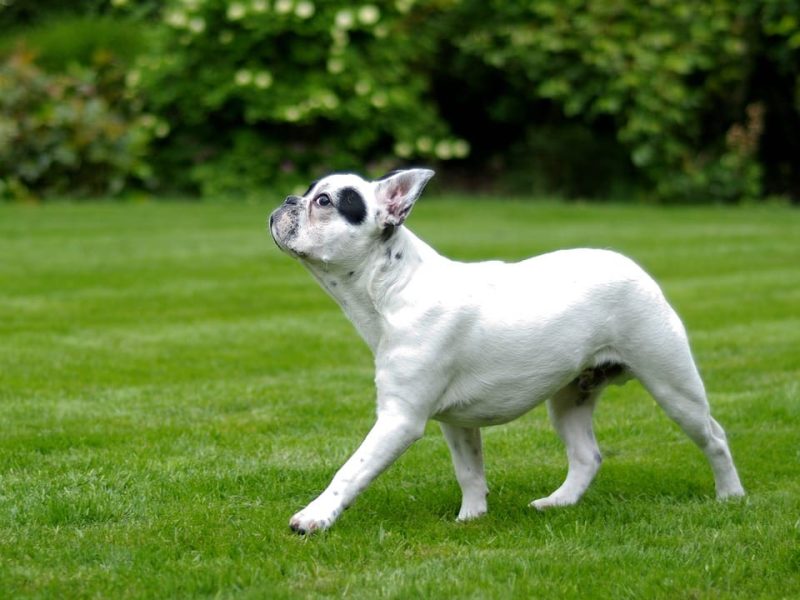
In other words dogs stot for the same reason that gazelles stot, because they are attracted to something, but feel insecure about making contact. They release this tension by hitting the ground primarily with their fore limbs, and this reduces their internal emotional charge. (This is also why horses stomp the ground when agitated.) It's an indirect manner of making contact with an object of attraction. 

Which returns me to the matter of conservation. There were other occasions when Barley's manner of locomotion made him look exactly like a bunny rabbit with his bouncy rear end trying to keep up with his stubby front end. So while Barley was a humorous study in contrasts, he was broadcasting not genetic fitness, but a fundamental principle of the conservation of information in genes. The prey remains within the predator. Carnivores of course evolved from herbivores and so the familiar maxim that you-are-what-you-eat can be tweaked into you-eat-what-you-are. Things are not the way they seem as everything in nature reflects something else. 


comments (0) >> click here

Why Do Dogs Lick Their Lips?

blog.lib.umn.edu
November 28, 2011
The interpretation by Turid Rugaas that lip licking is a calming signal has gained widespread standing in Dogdom and I agree that the licking of lips has a calming effect, (most especially for the one doing the licking), but not because it is an intentional signal. Rather, it speaks to something much deeper, a networked intelligence that works by way of physical memory, i.e. the stuff of feelings.

One clue that something larger is going on is that dogs often display these "signals," particularly yawning, when no one is looking and in fact they can be looking off to the distance with their back turned to the supposed target of their signal. Another interesting clue is that it occurs in disparate species with a completely different "Umwelt," such as horses. Monty Roberts writes that he once observed a dominant mare drive a rambunctious young stallion out of the herd and she only let him rejoin once he began to lick his lips. So in training he first drives a horse away from him, and then when it licks its lips, he lets it come toward him until at some point, usually within minutes, the horse willingly puts its head into a halter.

But if in my model the horse isn't signaling compliance to his "leader," or a dog isn't signaling a mark of appeasement or a peaceful state of mind to another, what then is going on in the mind of an animal licking its lips, as well as what's going on in the mind of the other animal that might happen to see this?

Emotional conductivity.

There are two emotional values, or "poles," and just like terminals in a battery, only when these are connected can the emotional juices flow. The flow of emotion as energy is what calms, not the mental transmission or reception of a so-called signal.

Just as a conversation can't happen if both people talk at once, emotion can't flow if both individuals are occupying the same polarity. The predator pole (-) is the one who projects energy, this is Roberts driving the horse away. The preyful polarity (+) is the one that absorbs energy as in the one licking its lips (or any other act of ingestion). When these polarities are clearly defined between two individuals (and they can flip from moment to moment), then the emotional circuit is connected and emotion can move between them. Both individuals feel good because they feel connected to each other and their movements and manner induce a feeling of motion and grounding within each other.

The principle of emotional conductivity, no matter at whatever high level of elaboration it may manifest as (such as "sinking our teeth" into a good book), is implemented by the oral urge and the biomechanics of ingestion and thereafter in emotional experience via the physical memory of same. This brain-to-gut connection is most vivid in the infancy of every animal in the urge to suckle, but it does not atrophy out of consciousness as the individual matures. Rather the brain-to-gut connection is how external objects of attraction are vicariously imported into the body/mind for emotional "digestion." And whenever something feels good, it is associated with the physical memory of being calmed, or grounded, by the act of ingestion. The oral urge and brain-to-gut connection serves as a template for the rest of an animal's life, the human animal included. The brain-to-gut connection is why we feel moved, or touched by something that feels right.

So the newborn puppy's jangled nerves at experiencing a sharp, hard, cold, bright world of intense stimulation at birth, is calmed the instant its mother's warm milk makes its way into its gut. This calming factor never goes away, this imprint serves as a standard for assaying everything it will encounter for the rest of its life. When it is stressed and yet strongly attracted to something, it will lick its lips from the physical memory of warm sustenance calming its body and mind.

An example of ingestion as the basis of emotional grounding we can find in human experience when we consider the first ten minutes of a cocktail party. I don't know about you but I'm not having fun. The atmosphere is tense, nervous laughing at jokes that aren't particularly funny, the breaking of ice is almost painful. But then with that first sip of a drink or taste of pate, the tension begins to melt and is soon replaced with the feeling of being grounded. Things are okay, I'm going to get out of here alive. I might even have fun. Which is really an odd thing because with our highly developed intellects, why can't we simply come together for scintillating conversation, why must every gathering or holiday revolve around food and drink?

Try this experiment. Wait for a moment when your dog is across the room or the yard and then show him a biscuit. What does he do? Invariably he licks his lips. Is he trying to calm you, appease you so you will give him what he desires, or is it more likely that he is already tasting the biscuit by way of a physical memory that has been imprinted into his body/mind from earlier experiences? Why doesn't he just run to the biscuit first without expending useless energy on licking at a distance? This is what Pavlov discovered. Dogs salivate to the conditioned sound of the bell, not because they are anticipating the taste of meat, or have been conditioned to associate the bell with the meat as if that is saying something, but rather because by virtue of conditioning they are already tasting the meat by way of the brain-to-gut connection as the substrate of the animal mind.

The physical memory of ingestion is also what's going on with Monty Robert's obstreperous stallion. The mare drives him out because the hectic energy he's projecting onto the herd is disrupting the emotional conductivity of the group. Simultaneously, the intensity of the pressure she brings to bear on him kindles within his body/mind the earliest of physical memories. By licking his lips the stallion indicates that emotionally he is shifting from the predatory to the preyful (soft) polarity. But he's not intentionally signally some kind of concept, "okay I'll behave." Instead, because the state of attraction between them is so strong and predicated on a deep, visceral imprint, he is reliving the feeling of being grounded into the first horse he has ever known, his mother, and he is reliving the taste of her milk. And as that feeling of grounding comes over him, the mare is able to feel connected to him again given his softened body manner. Her body softens in kind because his supple demeanor is but a higher elaboration for her of the same fundamental brain-to-gut connection. They have now reconstituted their emotional connection by way of the physical memory triggered within them, the reliving of a direct transfer of a very real physical energy, i.e. the nutrients ingested in their past. And the stallion has now learned to keep his energy within the confines of what the herd can conduct in order to retain the feeling of being grounded. He'll get his chance to project, but it will be now occur in sync with the herd rather than being unfocused and Helter Skelter. None of this is signaling, it's a collective calibration arising from the reliving of earliest imprints, which is why social animals have to be socialized by way of imprinting.

So for example, we have emotional experiences when we hear words uttered to us, but it's not the words that are the energy, rather the words convey a virtual energy by triggering physical memories of emotional states from our past. The internal dynamic produces the energy (hormones, synapses, neuro-chemicals, blood pressure, heart beats, glandular secretions, etc., etc.) that consumes us emotionally. And while there is indeed an actual transfer of energy by way of the words due to this internal affects, in reality no material energy arced across the gap. The energetic effects happen within our body/minds as we are induced to become either more or less conductive due to physical memories.

Now when it comes to human/dog relations we don't need to lick our lips so that our dog feels connected to us. When it comes to feelings the higher elaborations of a soft touch and a warm word will do just fine. The brain-to-gut connection is a many splendored thing.

comments (0) >> click here

Why Do Dogs Give Paw?

Stock Photo
October 26, 2011
From a Question and Answer Web Site:

"We used to have a Golden Retriever that would sit down and just look at us and give us his front paw. We always thought it was like him saying "please pet me." I tried to look online to see what this means but was unsuccessful. Do any of you guys know what this means?"

Best Answer - Chosen by Asker

In my house it means...

"Walk me......NOW"

"Dinner time, Lady... get up and make it happen"

"See these ears? they don't scratch themselves"

"Did I mention I want a walk...because I do"

" Your ice cream....hand it over."

"Overall, it means they want attention of some kind."

Many say that dogs use their body language in place of verbal language as if a dog is thinking: "If I do this, then my human will notice me and then do that." However I resist this interpretation because it's saying that dogs think just like we do, they just can't talk about it. And it doesn't diminish a dog to say its mind doesn't function exactly as ours does. Rather I believe the mind of an animal is fundamentally different from the intellectual mind of a human because the latter is predicated on the concept of Time. Also, we recognize that the basis of body language is involuntary and can operate far below the cognitive plane and so simply attaching thoughts to the behavior shouldn't satisfy our curiosity about its originating nature. So I suggest we return to the root of the behavior, the emotion, which I argue is a "force" of attraction, and then the subsequent feeling which arises from this as the basis of action. So putting the attention-soliciting idea aside, the question still remains why does a dog give paw in the first place, what is the actions' involuntary genesis?

In my view behavior is always in service to the movement of energy (rather than replication of genes) and so therefore there isn't a mental link made between cause and effect in terms of a chronology of events or obtaining a material benefit. For example, a behavior can bring a sense of relief to an animal while at the same time causing it harm and yet the behavior persists and gets stronger because this far more fundamental mandate of relieving tension is being satisfied. So I see the body/mind as a "pipe" or conduit for for the transmission of energy (emotion) and the biggest or main pipe in the body/mind is the oral urge. In other words when an animal, the human animal included, feels powerfully attracted to something, an involuntary urge to ingest is autonomically aroused in order to satisfy a visceral hunger for connecting with said object of attraction. (As in "You're so cute I could eat you up." or "I love that book, I could really sink my teeth into it.) A recent experiment demonstrated that when someone desires a new car or contemplates money, they actually salivate while looking at it.

http://www.sciencedaily.com/releases/2011/09/110914154408.htm

However behavior is more complex than just trying to put attractive things in the mouth, and so there is another level of complexity wherein, if (a) the force of attraction is strong enough and yet (b) the object of attraction cannot be ingested, then emotion is deflected to a secondary "pipe," i.e. the forelimbs, and the extremities (paws/hands) become "energized," i.e. sensually aroused. Thus humans feel the urge to grab/fondle objects of attraction with our hands while dogs feel the urge to paw at things. The degree to which this contact is sensual satisfies the primordial oral urge at the root source of the impulse.

The distinction we need to understand however is that the hardwired reflex to paw, while genetically preprogrammed, becomes imbued with the sensual component from the physical memory of litter experiences when first born pups use their front paws to knead their mother's mammary glands and which thereby induces a higher flow of milk. So the hardwired reflex plus the physical memory creates the emotional pipe of aroused paws since it has been indelibly imprinted with the feeling of flow. This imprint allows the adult dog to apply this behavior to a range of more complex situations so that when the dog finds itself emotionally moved, an object of resistance that through conditioning has become associated with that feeling of movement, such as an owner who has carefully house trained his puppy, can be made to move when the dog paws at him.

In my last post I referenced Dr. Wolpert's thesis that every level of the brain, even advanced intellectual cognition, is predicated on solving the problem of motion. (The concept of Time would be the ultimate elaboration of this, i.e. how long it takes to move a certain distance.) The emotional circuitry I'm postulating is consistent with this organization. When an animal is attracted to something, it feels moved, literally, and its oral urge is engaged. The stronger the force of attraction the greater the urge to ingest and the faster the dog would run to connect with such an object of attraction. And then if the object moves, this gratifies the oral impulse. However when there is resistance to movement, this enables the second stage of the emotional circuitry so that the front paws are aroused to paw at it. We see another version of this when a young dog encounters a puddle for the first time. He's attracted to it, especially if something is floating on the water, but is unsure at the same time, hence the perception of resistance between the oral urge and the dog's capacity to fulfill it and he paws at the water, occasionally lapping some up in order to satisfy the oral urge which is always at the root of any given behavior.

In the final analysis the dog isn't pawing at its owner with any of the above thoughts that were cited at the outset of this article. Rather the dog's mind is organized so that an object of attraction is assessed in terms of motion and/or in terms of resistance to motion. If there is a perception of resistance then emotional arousal shifts from the jaws to the fore limbs as the basis of a response. The physical memory of flow becomes affiliated with the physical movement of the body in motion, the front paws kicking out with every stride that leads the dog toward an object of attraction, and inversely and in mirror fashion, when the dog perceives something moving this too becomes synonymous with that same feeling of flow. So in essence, the dog isn't actually pawing at something in order to get it to move per se, even though its pawing may indeed have that effect, but rather the dog is in the tentative first stages of running-in-place because it already feels movement and is at the same time experiencing resistance. (Later I will explore this more deeply with the phenomenon of Pavlov's drooling dogs). And in mirror fashion, an owner feels an urge to get up and move as well, albeit with the understanding that when it comes to letting a dog outside to take care of matters, he better make it snappy.


comments (0) >> click here

One More Mirror Photo

File Photo
October 7, 2011
1 + 1 = 1
Another telling photo. It's hard here to see where one begins and the other ends.
comments (0) >> click here

Mirroring Photo

File Photo
October 7, 2011
In Alignment due to the Mirror Effect
This picture accompanies the article below.
comments (0) >> click here

Why Are Dogs A Mirror?

File Photo
October 7, 2011
This picture illustrates two dogs hard at "work" being each other's mirror. The phenomenon isn't unique to dogs of course and it's hardly a matter of work because mirroring is the nature of every emotional being. Horse and rider, are a mirrored pair, male reflects female and vice versa, the predator mirrors the prey it hunts, there is Yin and there is Yang, and when you think about it, training a dog to heel is teaching a dog to mirror his handlers' movements. Furthermore every breed of dog in personality and behavior is a reflection of the fight/flight characteristics of the prey it was selected to hunt. The new discipline of epigenetics (above-the-genes) reveals how genes are activated by environmental triggers. In other words, genes are not self-contained units of information, but need to be catalyzed in a sequential order so that in the final analysis an animal's phenotype reflects its surroundings, most especially, the emotional climate it finds itself in.

My point is that while the mirror phenomenon is indeed universal; it is nevertheless easiest to observe in dogs because of their high emotional capacity. And since the most powerful element in the emotional world of any dog is their owner, a dog's behavior and even its personality becomes molded to its owners' emotional makeup and I would go so far to say, its owner's emotional history to boot. It's as if an owner is a cast into which a dog is poured. What we see on the outside reflects what is felt on the inside.

To take it a step further, emotional capacity means coupling so that when one individual bonds with another; their energies (i.e. desires) fuse and they become one emotional feedback system. I use the term emotional capacity to indicate that this is a source of intelligence. The higher an individual's or species' emotional capacity the longer the process of entrainment can continue to elaborate into a more and more refined and perfectly calibrated reflection of the relationship, because each is able to mirror the other rather than being limited by fixed reflexes (genes) or habit.

On the other hand one might argue that mirroring is predicated on imitation, but I would counter that it's the other way around because the brain evolved to solve the most fundamental problem that organisms face in their evolution ---motion. I've provided a link to a talk given by Dr. Daniel Wolpert of Cambridge University in England who argues that even the highest reaches of cognition are elaborations upon how consciousness solved the problem of motion. http://learning.eng.cam.ac.uk/Public/Wolpert/KavliTalk

Dr. Wolpert points out that while IBM's Big Blue computer can defeat human grandmasters at chess, in the Artificial Intelligence world this is quite trivial as the most sophisticated robot is easily bested by a small child when it comes to the movement of the pieces on the chess board. Directed movement represents a stupendous feat of computation because of the problem of "noise." The organism must isolate the discrete movements it's executing from a constellation of competing feedback inputs, not only from the environment but within its own body as well, in order to filter out that which is extraneous to the manipulation of an object. I believe that emotion is the solution of this problem as it embodies the laws of motion in what I've termed the "Mirror Effect." Mirroring provides a platform upon which an animal's mind "elaborates" in a back and forth process in the phenomenon we otherwise call learning and mistakenly attribute to mental cognition. Motion is the basis of the brain, and mirroring is the basis of cognition.

Dr. Wolpert pursues a mathematical approach to the problem, but leaving that aside we laypeople can focus on the Mirror Effect with its own simple logic because something's going on inside the animal's mind that isn't mathematics. For example, while mathematics can describe music and is necessary in programming a computer to generate music, it doesn't explain what's going on inside our mind and bodies when we listen to music. So I propose the emotional logic that follows in order to explicate the animal mind.

The animal mind craves feedback. The animal moves and something changes and this provides feedback, even if it's only the change in its own perspective from having moved from one vantage point to another. But then when its movement causes an external element within its perceptual field to change, how does it discern whether or not this feedback is relevant and even more importantly, whether it's safe or even something beneficial? It is able to do so I contend because at the root of the Mirror Effect is Newton's Second Law of Motion, to wit: every action has an equal and opposite reaction.

An animal moves and something moves in response and thus an object materializes into the forefront of its mind. If the movement is incidental and occurring at random, it would at first be interesting and draw the animal's attention but would then soon fade into the background of the surrounding environment subsumed by all the other feedback inputs, it becomes noise. But if there was a direct one-to-one correspondence so that it always moved when one moves, then it would permanently arise out of the background and become an object of attraction that would increasingly occupy the animal's mind. We see this all the time when infant puppies are knocking around the litter box and cause something to move and then it begins to paw at it and becomes more fascinated as its movements provoke a consistent response. But then how does the individual know whether or not this movement, while relevant, is more or less relevant to other objects competing for its attention and more importantly, safe to explore further? This question is again answered by the mirror effect. If the dog goes toward something and the object goes away the exact same distance and at the same rate of speed, or if the dog moves away from the object and now the object reverses direction and comes closer and again at the same distance and rate of speed, and if the animal goes left and the object goes right, (since it is always mirroring in an equal manner), then this mirroring process would answer the safety question because it will soon come to feel that it can control what the object does by controlling what it does and so in this way an even greater degree of noise has been eliminated.

This then leaves the question of a hierarchy of relevance which is again answered by the Mirror Effect because the longer this mirroring process goes on, the greater the attraction the animal would feel for such an object until it reaches the point where it feels compelled to make contact beyond anything else reaching its senses.

However this then brings us to a paradox (and which interestingly parallels Zeno's paradoxes of motion), for if the "mirror effect" isolates objects of attraction from the background by eliminating noise, and then makes the animal feel safe and in control and simultaneously more and more attracted to the point where it's consuming all its attention, at the same time the animal is being prevented from making direct and intimate contact because of the block of dealing with something in the mirror. So how does the individual connect with the object of attraction when the desire between them becomes irresistible? Did the animal mind simply evolve to throw caution to the wind and go for it, or is the answer in the mirror as well?

If two beings are irresistibly attracted to each other and evolving to trust that an action will be met with an equal and opposite reaction so that it's safe to proceed further and further, and closer and closer, we will observe that all of this activity in their consciousness now guides them to orbit each other along a circle, the gap between them constantly narrowing until their collective desires converge on a midpoint, the epicenter of the circle. I call this the emotional midpoint or "emotional center-of-gravity." This provides the ultimate "ground" for two emotionally entangled individuals to get past the mirror effect around which the animal mind is organized. So what we're seeing in the pictures of the two dogs above, and what we see every time two dogs meet, greet and get along (and conversely what we don't see when two dogs meet and don't get along) is alignment around a midpoint so that their combined energies can come into phase and they can proceed along a common path. And for these two dogs living together in a human household, since the most important object within their consciousness is invariably their human being, their emotional center of gravity resides within their owner around which they align. So while we tend to think of the dog as divorced from the wild, and human domesticated life divorced from nature, our emotional natures are inescapable and remain wholly untamed. Indeed, nature is a mirror. And if we want to know what's going on within our heart, our dog is our mirror.

comments (0) >> click here

Why Do Dogs Shake?

August 2, 2011

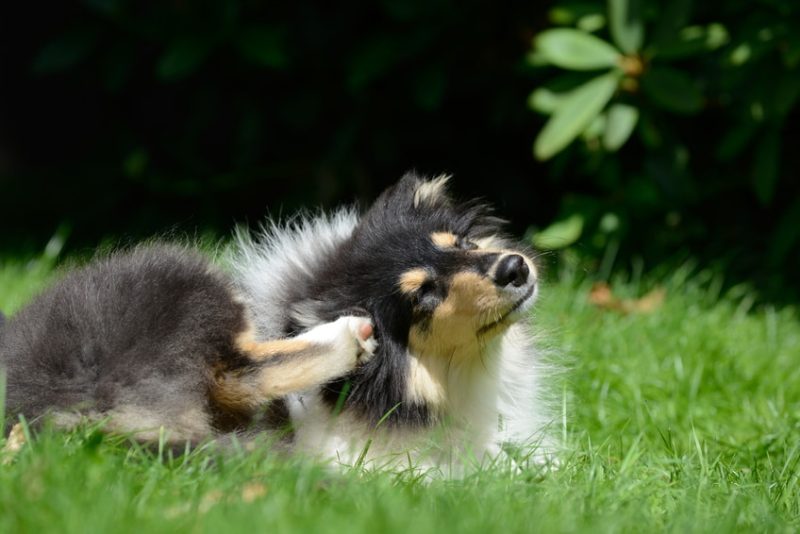
An athlete is hit hard in a game and is momentarily stunned with pain. The coach says "shake it off;" which he does, literally, either by wriggling the affected body part or by shaking his head to clear the cobwebs. Likewise, when the play between two dogs gets a little too rough, first one dog, and then invariably the other, stop what they're doing and then shake themselves off just as if they were drying off after a swim. At first this behavior seems straightforward enough, when we sustain a minor injury the rapid movement of muscles gets warm blood flowing into the area while simultaneously distracting us from the pain, and of course, post-swim, a dog wants to be rid of the heavy sheet of water enveloping their body. But that's not the whole story either because dogs do this even when physical contact hasn't yet been made or after a tentative first sniff of their partner.

Consider conducting the following experiment (but only presuming you know your dog is okay with it). Approach your dog and give him a nice big wrap around bear hug, pressing your cheek close to his head, then disengage and standing quietly, observe his response. Especially when a dog is indoors and can't deflect himself by doing something else, many dogs will shake themselves off just as if they've received a bop on the nose or have pulled themselves out of the water. Why?

Because as a human being I know that there aren't enough hugs going round the world: were someone I love to give me an unsolicited act of random kindness in the form of a big warm hug, I would willingly return such an embrace. But then I guess that's just me being mental given that the human intellect can process context. However since dogs don't process love on the mental stage, as human beings are capable of doing, they tend to respond quite differently and so you will probably see your dog step away and then shake off the hug.

The clue to the significance of the shake-it-off reflex can be found in another oft-heard coaches' bromide, "walk-it-off."Emotion is energy-in-motion, which is why the more emotional we feel the more animated we become and want to move. And as energy emotion has an internal dynamic of movement that works quite like the tides in that there is a rising and an ebbing effect. When emotion sweeps over us, we can feel it surge as if we're a tidal basin being flooded with a wave, and then these effects slowly subside and in fact can linger for a very long time. So in the animal mind, when there is an input of love that falls outside this natural rhythm, the canine mind doesn't necessarily process it as love, but rather as social pressure, which to a dog is equivalent to pain and since the emotional circuitry piggybacks on the most basic systems of physiology, the dog shakes it off.

From the Psychology Today Blog of Michael J. Formica:

"A recently published study suggests that intense feelings of social rejection are experienced in much the same way as physical pain. The study showed that the regions of our brain activated by physical pain are similarly activated when we are confronted with an intense experience of social rejection."

"The findings show that powerfully inducing feelings of social rejection activate regions of the brain also involved in the sensation of physical pain, while those same brain regions are rarely activated in neuroimaging studies of emotion. Kross remarks that this is consistent with the idea that the experience of social rejection -- or, more generally speaking, social loss -- appears to represent a distinct emotional experience uniquely related to physical pain."

And the best way to deal with rejection? Do what dogs do, shake it off and keep on moving. So my advice to dog owners wondering how to show affection to their dogs if hugging and kissing can be construed by a dog as social pressure---is to do onto their dog what they would pay for a masseuse to do onto them. A good massage is performed quietly and with a deep, kneading action that is calming rather than stimulating. If the masseuse patted our heads, scratched our sides, hugged us head to head and chatted up a storm, I daresay there's goes the tip. So to give a dog love, nothing beats a good rub-a-dub given slowly and deeply and I don't know of any dog that will shake off that kind of act of random kindness.

comments (0) >> click here