Eat, Drink, Sleep Flyball
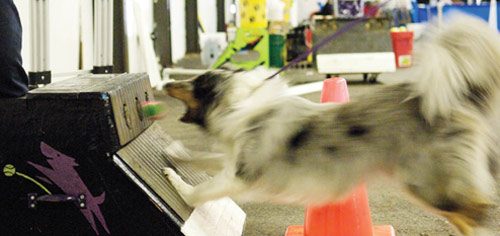
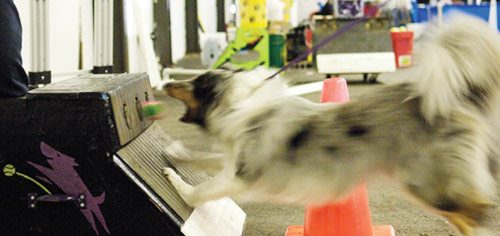
One taste of the wild, competitive sport of flyball and you’re hooked. Dogs utterly fascinated with balls race off-leash over a 51-foot course, along the way hurdling four jumps that are 10 feet apart. The size of the shortest dog on the team determines the jump height for that entire team. At the end of the course, the dog uses his or her feet to hit “the box”—a device that fires a tennis ball—then catches the ball and flies back over the jumps to the finish line. As the first runner crosses the line, the second dog in the four-dog team takes off. To make it even more exciting, these dogs are racing alongside another team of ball-hungry athletic canines.
Dima, Tia Arden’s black and white Border Collie, has only three legs, but true to her name which means powerful warrior, Dima lunges forward. Handler Tori Stewart strains to hold her at the start line. The blue light changes to yellow, to green. Dima takes off. She races to the first hurdle and clears it. To the second hurdle. The third. The fourth. She hits the box with her front foot. Boom! A tennis ball flies out. Dima swiftly snaps it up, turns around, and clears each hurdle once again. She crosses the finish line passing nose to nose with her teammate, Astro, an Appenzeller Sennenhund, who takes off to have his turn at the hurdles. Border Collie Joey and mixed-breed Tempus cheer their Rabid Racer teammates on with barks as if to exclaim, “Run, Dima, Run!” “Get that ball, Astro!”
One taste of the wild, competitive sport of flyball and you’re hooked. Dogs utterly fascinated with balls race off-leash over a 51-foot course, along the way hurdling four jumps that are 10 feet apart. The size of the shortest dog on the team determines the jump height for that entire team. At the end of the course, the dog uses his or her feet to hit “the box”—a device that fires a tennis ball—then catches the ball and flies back over the jumps to the finish line. As the first runner crosses the line, the second dog in the four-dog team takes off. To make it even more exciting, these dogs are racing alongside another team of ball-hungry athletic canines.
The North American Flyball Association (NAFA; flyball.org), is one of several groups that oversee the sport. NAFA’s records tournaments for over 700 clubs and 16,000 registered dogs.
Flyball is a sport for all dogs, including mixed breeds. Races are run with teams of equal abilities competing. Infractions requiring a dog to be rerun include false starts, missed jumps, not bringing the ball back, and not triggering the box. The race is won by the first team to have all four dogs cross the finish line without error.
The Bare Bones Flyball Tournament in Langley, British Columbia, draws competitors from British Columbia, Washington, Oregon, and as far away as San Diego, California, to match their speed in the eighty-four races run over this particular September weekend. One of the local clubs, the Toonies Non Stop Noise Club from Coquitlam, B.C., is headed by Elsie-May Lang who began teaching flyball in 1984 at the Old Orchard Hall in Port Moody and who was part of the flyball demonstrations presented at the Vancouver Expo ’86 World’s Fair. Known as the “Grandmother of Flyball in B.C.,” Lang has taken many potential competitors under her wing to fly through the courses of training and join the Toonies club.
Lang explains that dogs chosen to do flyball should be “ball-crazy and well-built.”
“Like any athlete, they must be in good condition and exercised daily, muscle tone is a must,” she says. “The most popular breeds are the Border Collie, Jack Russell, and Border/Jack-cross, although there are many breeds that are well represented in the sport.”
The Toonies practice at Cedarbrook Stables in Langley, B.C. The cost to members is $40 and $20 for a second family member. Drop-ins are allowed for a $5 fee, allowing newcomers to see if the sport suits them.
“People who join have to be team players,” Lang says. “First thing we do is teach the dogs to jump over low jumps and we train the dogs to do a ‘swimmer’s turn’ on the box.” Triggering the box can be tricky. Some dogs stop and bark at the box to release the ball. Lang describes how one Border Collie ran to the box, laid down, and stared at the box, willing it to give up the ball.
Eventually, beginner dogs will train with more seasoned ones, learning how to pass “nose-to-nose” at the start/finish line and strive to complete their leg of the relay race in four seconds as dogs are doing at the Bare Bones tournament.
At the Bare Bones Tournament, Lang is racing Brandi, an 11-year-old black Australian Shepherd who holds the title of Grand Champion, and Guy—aka the “Infamous Guy”—a Jack Russell Terrier known for keeping everyone in stitches with his comedic antics. “Once he hit the jump, somersaulted over, picked himself up, shook himself off, got the ball, and continued on his way,” Lang recalls. “He’s known to go to the box and look around to see who else is racing.”
The Toonies finish their race in good form and little 5-year-old Maggie Rebidue, official “ball shagger” and youngest club member, does her job. She enters the ring, collects all the balls and puts them in her basket.
“We train them young,” Lang says. “They are the children; the future of the game.”
Fiona Wray, another flyballer trained by Lang, loves the game so much that she keeps a flyball box in her living room so she and her dog can practice.
“Flyball attracted me because it was, first and foremost, fun,” she says. “I adopted a puppy from the SPCA who was very bright, very active and needed something to do. Being a mixed breed, she wasn’t allowed to compete in Canadian Kennel Club events, so when I saw that flyball was being offered in the area, I signed her up. The appeal for my [current] dog, Tempus, is running, jumping, barking, and tugging! All day! Woo hoo! It’s an opportunity for him to completely indulge his manic ball-obsessed side.”
The strong social aspect appeals to many flyballers. Lang says: “Over the years I’ve met many wonderful people and their dogs and have enjoyed many weekends racing and competing with these people.”
Sara Henderson, data analyst for the University of British Columbia and member of the Rabid Racers says: “My work requires me to spend long hours at the computer. Flyball provides a really nice mental and physical break from the usual routine, allowing me to have fun with my dogs and my friends.”
Late Sunday evening, the Bare Bones Tournament comes to a close. Lawn chairs, kennels, and remnants of snacks have been picked up and packed into cars, SUV’s, and motor homes. Good times have been had, goodbyes have been said. Barks have been barked. Dogs are curled up on seats of cars, eyes closed. Car engines hum, bringing them to slumber. Paws begin stirring, legs twitching, running in the air. Dreaming of the perfect run. Dreaming flyball.
Join the newsletter and never miss out on dog content again!
"*" indicates required fields
By clicking the arrow, you agree to our web Terms of Use and Privacy & Cookie Policy. Easy unsubscribe links are provided in every email.